Laia Domingo and colleagues at EigenOrbit Sàrl have created eigenkit, a new quantum computing library supporting 12 execution providers spanning both simulators and actual quantum hardware. The library separates algorithm design from execution, enabling systematic comparison of the same quantum algorithm across diverse environments.
Experiments using IBM Heron and IQM Emerald processors revealed that a processor’s suitability for a given algorithm depends on how well the algorithm’s structure aligns with the processor’s physical connectivity, demonstrating that backend portability is important for both computational efficiency and quantum execution quality. eigenkit also integrates with standard scientific tools like NumPy, PyTorch and scikit-learn.
Provider-Neutral Execution Across 12 Backends
Currently, eigenkit supports execution across 12 distinct providers, encompassing both quantum simulators and access to actual quantum hardware; this broad compatibility represents a step towards achieving genuinely portable quantum code. These providers include in-house numpy simulators, PennyLane, Qiskit Aer, CUDA-Q, TensorCircuit, Qulacs, qsim, and QPUs accessed through Qiskit Runtime, IQM Resonance, Quandela’s Perceval and Amazon Braket. The library’s design deliberately avoids replacing existing quantum frameworks, instead functioning as an abstraction layer intended to simplify the movement, comparison, differentiation and integration of algorithms between them.
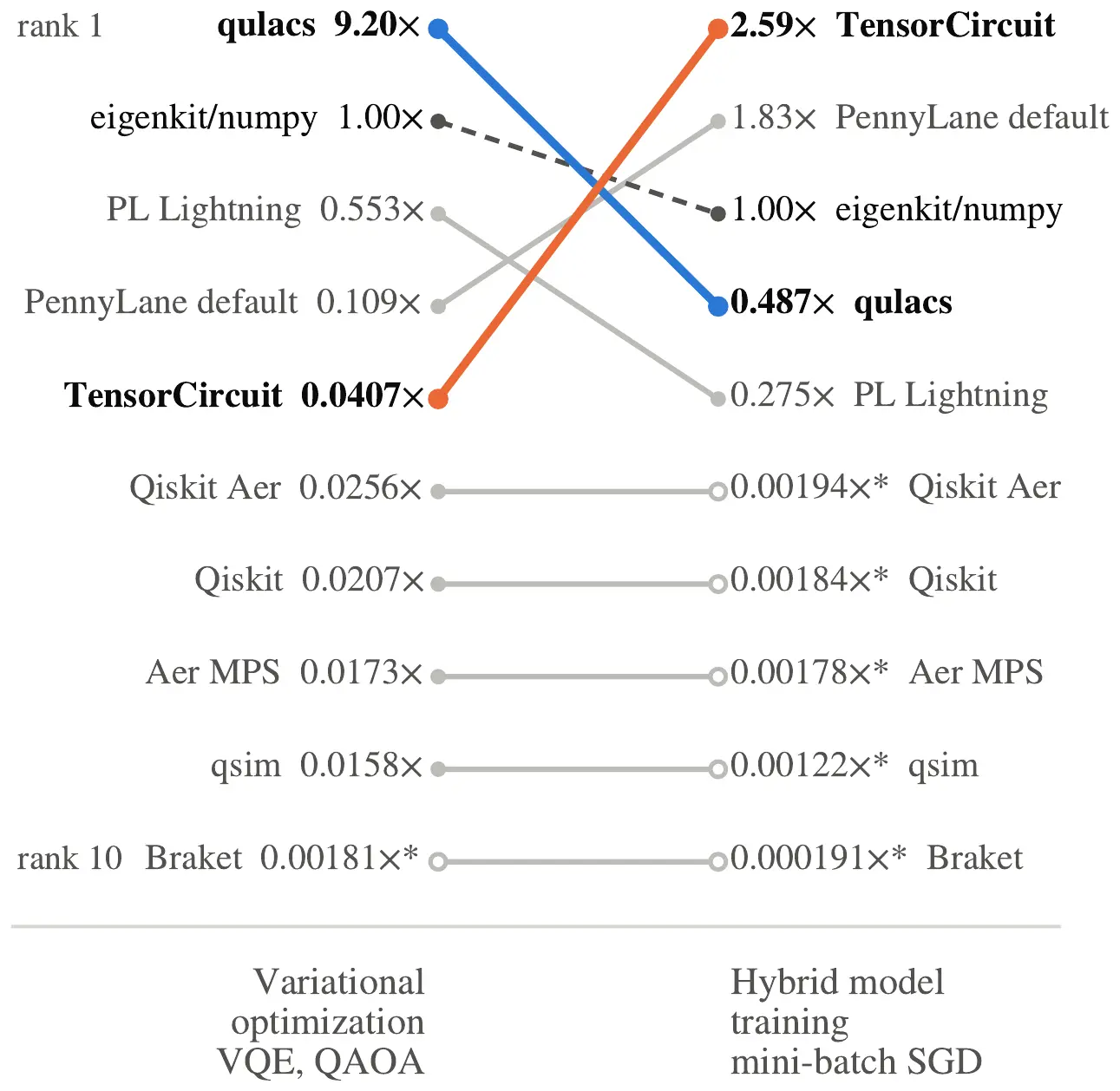
This separation of algorithm definition from backend execution impacts computational efficiency and quantum execution quality, as shown in experiments detailed in the work. Researchers evaluated several simulation backends using different quantum workloads, revealing substantial performance variations based on circuit size, structure, batching and the specific application being run.
The results indicate that no single simulation backend consistently outperforms others, highlighting the workload-dependent nature of optimal backend selection. The library also provides backend-independent gradient computation, a feature that facilitates integration with standard scientific computing and machine-learning workflows through interfaces with NumPy, PyTorch and scikit-learn.
The ability to define a circuit once and execute it with minimal code changes across multiple backends simplifies the process of benchmarking and comparing performance. “This makes it easier to compare backends and select the one that is better suited to a particular workload without modifying the high-level implementation,” the paper states.
The researchers demonstrated this capability with an IQP (indefinite causal order) circuit, successfully running the same program across various simulators and quantum hardware backends, as illustrated in Listing 1. This approach allows for systematic evaluation of different execution environments, identifying the best-performing backend for a specific quantum task. The design of eigenkit centers around a provider protocol, a compile/run split, and consistent estimator interfaces, ensuring a unified approach across diverse platforms.
This modularity allows for the reuse of the same design principles when integrating new backends, streamlining the expansion of supported environments. The work demonstrates that backend choice is workload dependent, reinforcing the need for tools that facilitate easy comparison and selection of the optimal execution environment for a given quantum algorithm.
eigenkit’s Circuit Representation and Layered Architecture
Separating how a quantum algorithm is built from where it runs via a circuit representation, eigenkit allows for a single circuit description to be used across 12 different execution providers. This intermediate representation (IR) defines a circuit as a list of gates, the qubits they act upon, and their parameters, storing no numerical values until execution, and enabling a consistent interface for both simulators and quantum hardware.
This approach allows developers to define a model at varying levels of abstraction, compiling it into this backend-independent form before running it on the chosen platform. The library’s architecture demonstrates substantial performance variance among simulators depending on circuit characteristics, revealing that no single simulator consistently outperforms others. This finding highlights the importance of selecting the appropriate simulator based on the specific demands of the quantum algorithm being tested.
Backend-Independent Gradient Computation for Differentiation
This broad compatibility is a deliberate design choice intended to simplify the process of moving quantum algorithms between different platforms without extensive code modification. The library’s architecture separates the algorithm’s definition from the specific backend used for execution, using a common circuit representation and provider interface to achieve this decoupling. This integration allows developers to use familiar machine-learning workflows with quantum components, enabling the creation of hybrid quantum-classical pipelines.
When an execution provider offers its own gradient calculation method, such as PennyLane’s differentiation tools or the adjoint method in the built-in simulator, eigenkit uses those native capabilities. Otherwise, the library automatically falls back to its own in-house parameter-shift rule, ensuring consistent functionality across diverse backends.
Simulator performance varies substantially with circuit size, structure, batching and application workload. The library’s modular design facilitates the addition of new backends, further streamlining the process of identifying best-performing execution environments. This approach allows researchers and developers to focus on the core logic of their quantum algorithms without being constrained by the specifics of the underlying hardware or simulator.
The team has implemented utilities for several application domains, including quantum neural networks, quantum reservoir computing and quantum support vector machines, alongside quantum chemistry tools and algorithms like iterative quantum amplitude estimation and Harrow-Hassidim-Lloyd (HHL). The current suite of supported providers includes CUDA-Q, and Perceval for photonics quantum computing, alongside more established options like Qiskit and Qulacs. This diverse range of backends reflects a commitment to supporting a broad spectrum of quantum computing technologies and programming models.
By providing a consistent interface across these platforms, eigenkit aims to accelerate the development and deployment of quantum algorithms for a wider range of applications. The library’s lightweight and modular dependency structure further enhances its flexibility and ease of use, allowing developers to integrate it smoothly into existing projects. The team emphasizes that the goal is to provide an abstraction layer that makes quantum algorithms easier to move, compare, and integrate across different frameworks, ultimately encouraging innovation and collaboration within the quantum computing community.
Integration with NumPy, PyTorch, and scikit-learn
Eigenkit currently supports 12 execution providers, encompassing both quantum simulators and physical quantum hardware, a level of integration designed to ease portability across diverse computing platforms. This broad compatibility extends beyond simply running code on different machines; the library facilitates backend-independent gradient computation, a critical feature for training quantum machine learning models. By enabling this functionality, eigenkit allows developers to move differentiable quantum models between backends without altering their optimization workflows.
The library’s design directly addresses the need to integrate quantum algorithms with established scientific computing tools. Quantum models can interface with NumPy and PyTorch, while estimators are structured to follow scikit-learn-style fit/predict workflows. This integration allows quantum components to be incorporated directly into existing classical machine-learning pipelines, potentially accelerating the development of hybrid quantum-classical algorithms.
The core of eigenkit depends only on NumPy and SciPy, minimizing initial dependencies, with other frameworks and backends installed only when needed, streamlining the user experience. Beyond core functionality, eigenkit includes modules for quantum machine learning, optimization and quantum chemistry. The qml module provides scikit-learn-compatible quantum estimators, including fidelity-based quantum kernels and quantum support-vector classifiers. A dedicated PyTorch interface makes circuits differentiable within the PyTorch framework, exposing them as neural network layers and supporting common hybrid patterns like angle encoding and data re-uploading.
The library also offers tools for formulating and solving quadratic unconstrained binary optimization and Ising problems, alongside a Variational Quantum Eigensolver solver. This modular structure, coupled with the ability to evaluate the same implementation across different execution environments, aims to make heterogeneous quantum computing more accessible.
The developers envision a workflow where backend choice remains flexible throughout algorithm development and deployment. The library, released under the Apache License 2. 0 and available via pip install eigenkit, version 1. 0. 0, provides a foundation for systematic comparison and application development across a growing landscape of quantum computing technologies.
Simulator and QPU Performance on IBM Heron & IQM Emerald
The performance of quantum simulators varies substantially depending on the specific task, with no single backend consistently preferable across all workloads. Researchers found that a simulator optimized for single circuit execution may perform poorly when used for large-batch training of a hardware quantum neural network, highlighting the need for careful selection of simulation tools during development. This choice of software development kit can significantly impact development time, as tying a user to a specific set of simulators introduces performance dependencies.
The experiments encompassed both basic variational ansätze and implementations of VQE, QAOA, and HQNN algorithms, revealing subtle performance differences. Experiments on IBM Heron and IQM Emerald demonstrated that the topology of the quantum algorithm contributes to determining which processor performs better, since two-qubit operations remain a major source of error on current quantum processing units, this additional routing overhead can directly affect execution quality.
The impact of this topological alignment was quantified by comparing the root mean squared error (RMSE) and slope of results obtained on both processors. The analysis, restricted to observables of weight at most four, revealed that the choice of device can significantly impact the accuracy of results. The researchers state that different IQP architectures can therefore be preferable for different tasks, emphasising the importance of considering hardware topology when designing and executing quantum algorithms.
High-Level Functionality: Quantum Machine Learning & Optimization
The eigenkit library exposes a common gradient interface across execution backends, using native differentiation where available and parameter-shift methods otherwise, enabling smooth movement of differentiable quantum models between simulators and quantum processing units without altering optimization workflows. This feature supports a flexible approach to algorithm development, allowing researchers to evaluate performance across diverse hardware and software environments with minimal code modification. The library’s design prioritizes backend-agnostic optimization, a departure from traditional workflows that often require significant adjustments when switching between execution platforms.
The library’s modular structure, with layers dedicated to algorithms, circuits and providers, further enhances its adaptability and extensibility, allowing developers to easily incorporate new functionalities and backends. 0. 0, provides a foundation for systematic comparison and application development across a growing landscape of quantum computing technologies.
👉 More information
🗞 eigenkit: A Provider-Neutral Quantum Computing Library
✍️ Laia Domingo, Daniil Tarpanov, Arsenii Senokosov and Asel Sagingalieva
🧠 ArXiv: https://arxiv.org/html/2611.02979v1




See today’s quantum computing news on Quantum Zeitgeist for the latest breakthroughs in qubits, hardware, algorithms, and industry deals.